Benefits of multibreed genetic evaluation
1. Provides breeders with better tools for genetic improvement
Multibreed beef genetic evaluations will deliver a suite of new selection tools to cattle breeders, including:
- Australian Cattle Breeding Values (ACBVs)
- Australian Cattle Genomic Values (ACgVs)
- Australian Cattle Genetic Profiles (GenProfiles).
Together, these tools will help accelerate genetic gain by providing more accurate measures of genetic merit, boosting productivity, profitability and sustainability across the beef supply chain.
How multibreed evaluations will help commercial beef producers
Multibreed beef genetic evaluations are particularly advantageous to commercial beef producers.
Using Australian Cattle Breeding Values, commercial producers can directly compare bull genetics across breeds, helping them better capture genetic variation and improve crossbreeding outcomes.
Multibreed beef genetic evaluation will also provide commercial producers with access to new tools not previously available from national, single-breed BREEDPLAN genetic evaluations. For example, Australian Cattle Genetic Profiles will provide commercial beef breeders with an across-breed, genetic benchmark of their herd, better informing bull purchasing decisions and enabling commercial herds to track genetic progress over time.
Similarly, the availability of Australian Cattle Genomic Values will provide commercial beef breeders with an across-breed genomic prediction of an animal’s genetic merit based on an animal’s genomic (or DNA) profile, facilitating precision selection of replacement heifers in a commercial breeding operation, along with precision sorting and/or marketing of steers into lines suitable for the different paths in the beef supply chain.
Support for seedstock producers
While commercial producers are expected to gain significant value, seedstock breeders will also benefit from a multibreed evaluation system.
The ability to directly compare animals across breeds will allow seedstock producers to market genetics more effectively to commercial operations running different breed types. For example, seedstock breeders will be able to objectively demonstrate the genetic merit of their bulls to producers with a different breed of females. This creates new opportunities for seedstock producers to access a broader customer base and clearly communicate the value of their genetics.
Multibreed genetic evaluations are also advantageous to seedstock breeders with composite and crossbred animals, which are often poorly represented or excluded from traditional single-breed evaluations. Multibreed genetic evaluation provides a framework for analysing these animals alongside straightbred populations, ensuring that all seedstock animals can be incorporated in national genetic evaluations, irrespective of breed.
2. Realises the benefit of research by MLA and industry partners
Over many years, significant investments have been made by Meat & Livestock Australia (MLA) and industry partners to collect sufficient data to underpin the design and delivery of commercial multibreed beef genetic evaluations.
Approximately $40 million of R&D investments have been made since 2016, including the renowned Repronomics and Southern Multibreed Beef projects.
The establishment of multibreed genetic evaluations ensures the value of this industry-funded research is fully realised, delivering multibreed breeding values and selection tools, and turning research investments into tangible outcomes that deliver improved productivity, greater sustainability, and enhanced profitability across the beef supply chain.
3. Consolidation of evaluations for better product and service delivery
More than 20 single-breed genetic evaluations are currently conducted in Australia using BREEDPLAN software.
Multibreed genetic evaluation consolidates these single-breed analyses into a small number of core genetic evaluations, reducing duplication and greatly improving the efficiency of product and service delivery.
Consolidated multibreed genetic evaluations enable resourcing to focus on maintaining and enhancing a limited number of genetic evaluations, rather than duplicating effort across multiple genetic evaluations. This supports faster and more agile technology adoption, more frequent enhancements and better integration of new tools.
The outcome is a stronger and more sustainable national genetic evaluation ecosystem that provides greater value to breeders, commercial producers, service providers and the broader beef industry.
4. Establishes a standard industry language for describing genetic credentials of commercial animals
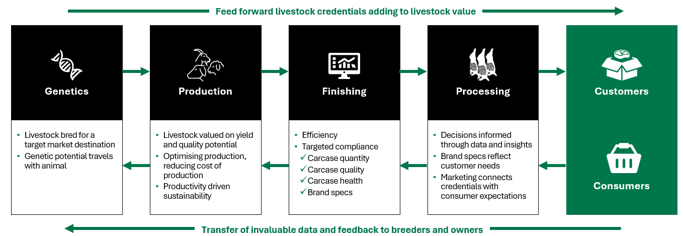
Multibreed genetic evaluation provides a common way to describe genetic merit across breeds, allowing commercial animals to be sold with an industry-recognised measure of their genetic value.
Better information on the genetic merit of commercial animals (carried with them through the supply chain) strengthens the link between genetics and performance, helping to ensure genetics are appropriately valued.
This will drive demand for superior genetics through the introduction of clearer price signals, transitioning the breeding industry to an operating environment where the beef supply chain drives the seedstock sector to produce genetics that are more closely aligned to market requirements. See graphic below.